Jacqui Poncelet: Carpet
The Spotlight Series, Arts Council Collection 1994
National Touring Exhibitions, The South Bank Centre, London
Spotlight on Jacqui Poncelet
‘He directed that the river, which was frozen to a depth of twenty feet and more for six or seen miles on either side, should be swept, decorated and given all the semblance of a park or pleasure ground, with arbours, mazes, alleys, drinking booths, etc., at his expense. For himself and the courtiers, he reserved a certain space immediately opposite the Palace gates; which, railed off from the public only by a silken rope, became at once the centre of the most brilliant society in England. Great statesmen, in their beards and ruffs, despatched affairs of state under the crimson awning of the Royal Pagoda. Soldiers planned the conquest of the Moor and the downfall of the Turk in striped arbours surmounted by plumes of ostrich feathers. Admirals strode up and down the narrow pathways, glass in hand, sweeping the horizon and telling stories of the north-west passage and the Spanish Armada. Lovers dallied upon divans spread with sables. Frozen roses fell in showers when the Queen and her ladies walked abroad. Coloured balloons hovered motionless in the air. Here and there burnt vast bonfires of cedar and oak wood, lavishly salted, so that the flames were of green, orange and purple fire. But however fiercely they burnt, the heat was not enough to melt the ice which, though of singular transparency, was yet of the hardness of steel. So clear indeed was it that there could be seen, congealed at a depth of several feet, here a porpoise, there a flounder. Shoals of eels lay motionless in a trance, but whether their state was one of death or merely of suspended animation which the warmth would revive puzzled the philosophers.’ [1]
This passage appears early in Virginia Woolf’s fiction of the phenomenal life of Orlando. She describes the onset of the Great Frost, in the reign of James I, as a sudden and instantaneous breath. The most vivid effect of this frost is the transformation of the River Thames into an ice as transparent as glass. Below this surface the serpentine vitality of submarine life is fixed. This fixity becomes a spectacle available to all of London, for all of London’s societies migrate on to the ice. Both the unruly and vulgar carnival of the town folk and the elaborate choreography of courtly intercourse leave the seclusion of their streets and buildings to perform with permissive rudeness on the exposed plane of the frozen river.
These events take place, therefore, out of place. New topographies of social relations are mapped out on the surface of the ice, while spread below everyone’s feet, like a carpet, the previously secretive life of an underwater world becomes visible.
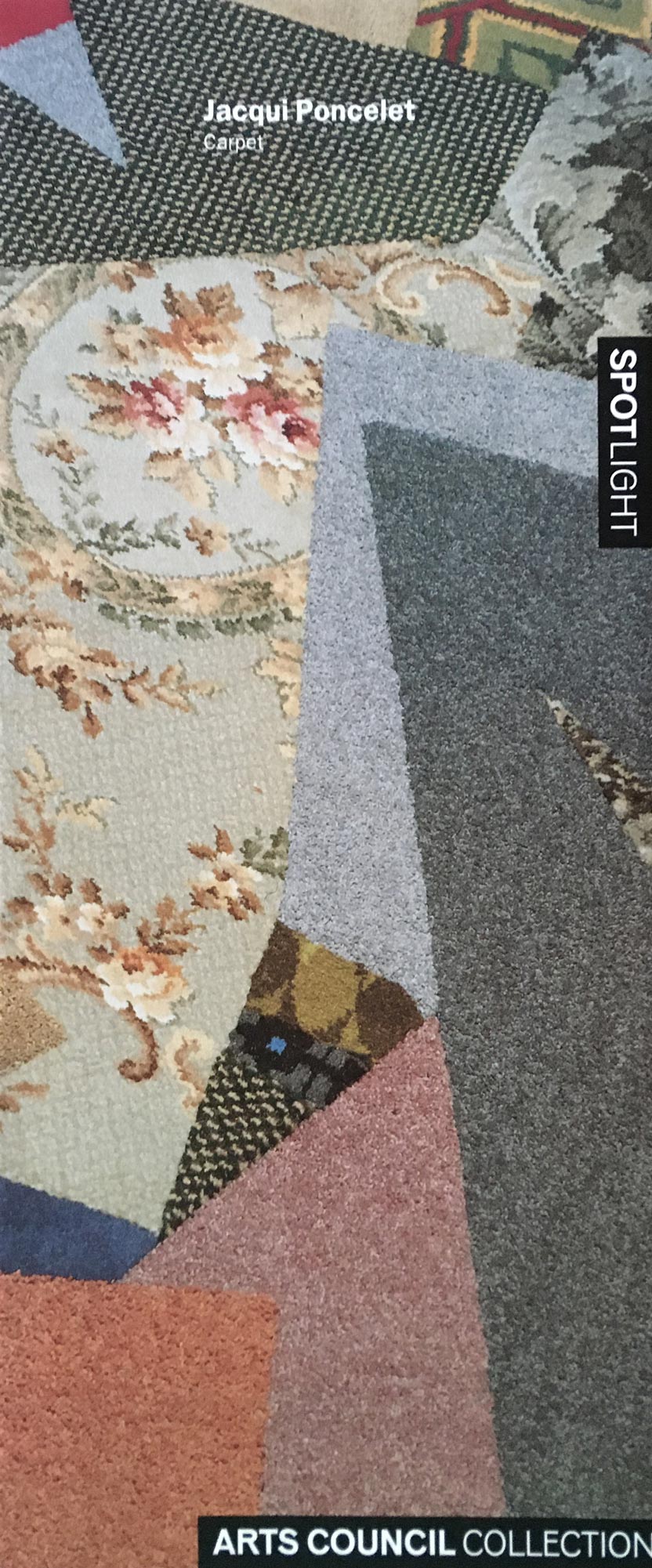
As I gaze down into Jacqui Poncelet’s Carpet, numerous interwoven themes begin to surface that bring to mind Woolf’s spectacular picture and that frequently recur in Poncelet’s work. Embracing a wide range of materials and media, her work manifests an elaborate density of detail, layerings of mark and touch, an unfixing of certainties of material and of the identities of objects, and a frank and imprudent sexuality in the confluence of form, material and importantly, surface pattern.
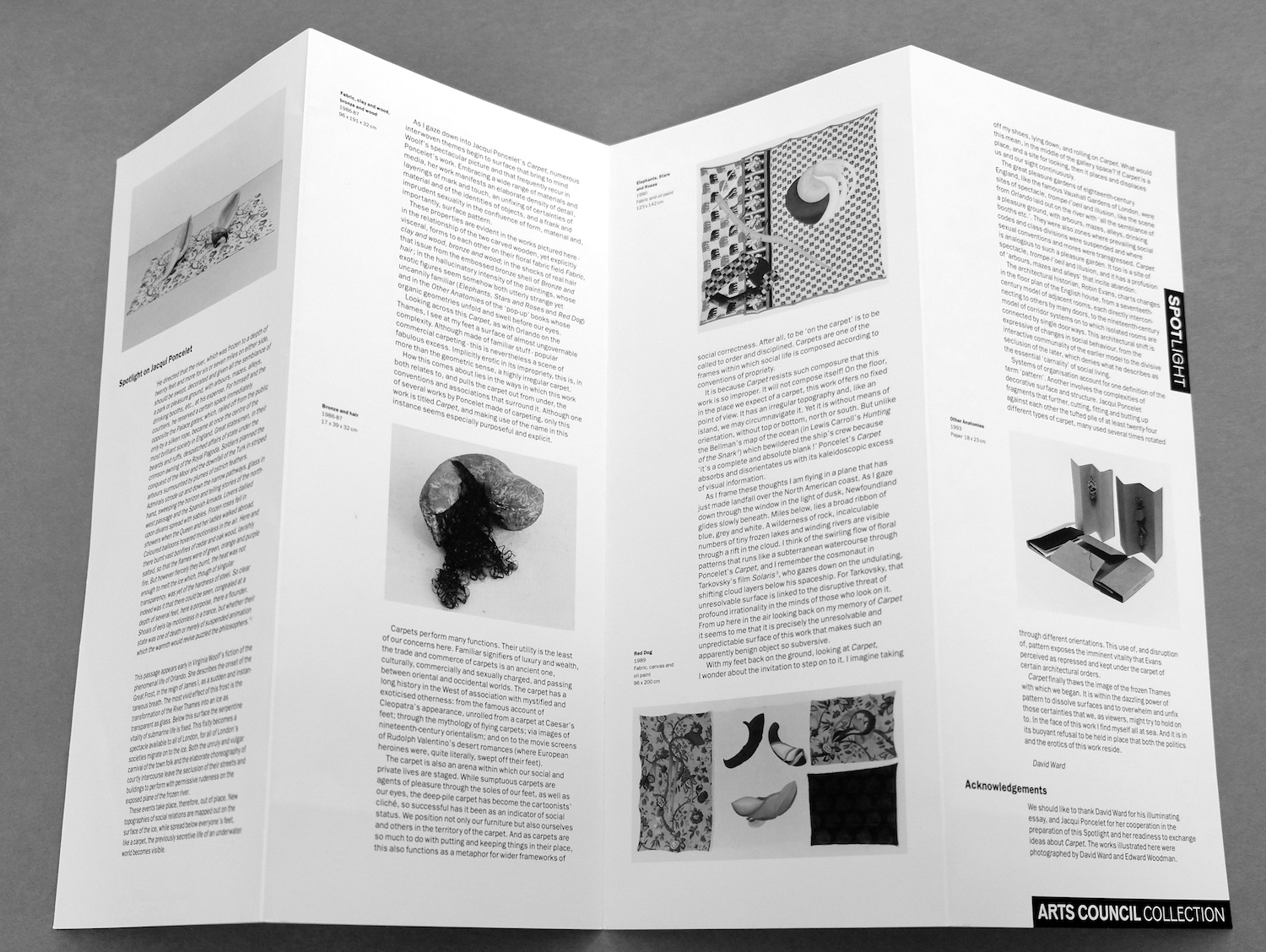
These properties are evident in the works pictured here – in the relationship of the two carved wooden, yet explicitly visceral, forms to each other on their floral fabric field Fabric, clay and wood, bronze and wood; in the shocks of real hair that issue from the embossed bronze shell of Bronze and hair; in the hallucinatory intensity of the paintings, whose exotic figures seem somehow both utterly strange yet uncannily familiar (Elephants, Stars and Roses and Red Dog) and in the Other Anatomies of the ‘pop-up’ books whose organic geometries unfold and swell before our eyes.
Looking across this Carpet, as with Orlando on the Thames, I see at my feet a surface of almost ungovernable complexity. Although made of familiar stuff – popular commercial carpeting – this is nevertheless a scene of fabulous excess. Implicitly erotic in its impropriety, this is, in more than the geometric sense, a highly irregular carpet.
How this comes about lies in the ways in which this work both relates to, and pulls the carpet out from under, the conventions and associations that surround it. Although one of several works by Poncelet made of carpeting, only this work is titled Carpet, and making use of the name in this instance seems especially purposeful and explicit.
Carpets perform many functions. Their utility is the least of our concerns here. Familiar signifiers of luxury and wealth, the trade and commerce of carpets is an ancient one, culturally, commercially and sexually charged, and passing between oriental and occidental worlds. The carpet has a long history in the West of association with mystified and exoticised otherness: from the famous account of Cleopatra’s appearance, unrolled from a carpet at Caesar’s feet; through the mythology of flying carpets; via images of nineteenth-century orientalism; and on to the movie screens of Rudolph Valentino’s desert romances (where European heroines were, quite literally, swept off their feet).
The carpet is also an arena within which our social and private lives are staged. While sumptuous carpets are agents of pleasure through the soles of our feet, as well as our eyes, the deep-pile carpet has become the cartoonists’ cliché, so successful has it been as an indicator of social status. We position not only our furniture but also ourselves and others in the territory of the carpet. And as carpets are so much to do with putting and keeping things in their place, this also functions as a metaphor for wider frameworks of social correctness. After all, to be ‘on the carpet’ is to be called to order and disciplined. Carpets are one of the frames within which social life is composed according to conventions of propriety.
It is because Carpet resists such composure that this work is so improper. It will not compose itself! On the floor, in the place we expect of a carpet, this work offers no fixed point of view. It has an irregular topography and, like an island, we may circumnavigate it. Yet it is without means of orientation, without top or bottom, north or south. But unlike the Bellman’s map of the ocean (in Lewis Carroll’s Hunting of the Snark [2]) which bewildered the ship’s crew because ‘it’s a complete and absolute blank!’ Poncelet’s Carpet absorbs and disorientates us with its kaleidoscopic excess of visual information.
As I frame these thoughts I am flying in a plane that has just made landfall over the North American coast. As I gaze down through the window in the light of dusk, Newfoundland glides slowly beneath. Miles below, lies a broad ribbon of blue, grey and white. A wilderness of rock, incalculable numbers of tiny frozen lakes and winding rivers are visible through a rift in the cloud. I think of the swirling flow of floral patterns that runs like a subterranean watercourse through Poncelet’s Carpet, and I remember the cosmonaut in Tarkovsky’s film Solaris [3], who gazes down on the undulating, shifting cloud layers below his spaceship. For Tarkovsky, that unresolvable surface is linked to the disruptive threat of profound irrationality in the minds of those who look on it. From up here in the air looking back on my memory of Carpet it seems to me that it is precisely the unresolvable and unpredictable surface of this work that makes such an apparently benign object so subversive.
With my feet back on the ground, looking at Carpet, I wonder about the invitation to step on to it. I imagine taking off my shoes, lying down, and rolling on Carpet. What would this mean, in the middle of the gallery space? If Carpet is a place, and a site for looking, then it places and displaces us and our sight continuously.
The great pleasure gardens of eighteenth-century England, like the famous Vauxhall Gardens of London, were sites of spectacle, trompe-l’oeil and illusion, like the scene from Orlando laid out on the river with ‘all the semblance of a pleasure ground, with arbours, mazes, alleys, drinking booths etc.’. They were also zones where prevailing social codes and class divisions were suspended and where sexual conventions and mores were transgressed. Carpet is analogous to such a pleasure garden. It too is a site of spectacle, trompe-l’oeil and illusion, and it has a profusion of ‘arbours, mazes and alleys’ that incite abandon.
The architectural historian, Robin Evans, charts changes in the floor plan of the English house, from a seventeenth-century model of adjacent rooms, each directly interconnecting to others by many doors, to the nineteenth-century model of corridor systems on to which isolated rooms are connected by single doorways. This architectural shift is expressive of changes in social behaviour, from the interactive communality of the earlier model to the divisive seclusion of the later, which denies what he describes as the essential ‘carnality’ of social living.
Systems of organisation account for one definition of the term ‘pattern’. Another involves the complexities of decorative surface and structure. Jacqui Poncelet fragments that further, cutting, fitting and butting up against each other the tufted pile of at least twenty-four different types of carpet, many used several times rotated through different orientations. This use of, and disruption of, pattern exposes the imminent vitality that Evans perceived as repressed and kept under the carpet of certain architectural orders.
Carpet finally thaws the image of the frozen Thames with which we began. It is within the dazzling power of pattern to dissolve surfaces and to overwhelm and unfix those certainties that we, as viewers, might try to hold on to. In the face of this work I find myself all at sea. And it is in its buoyant refusal to be held in place that both the politics and the erotics of this work reside.
David Ward
- Virginia Woolf, Orlando, Penguin Books, 1993, pp.24-25
- Lewis Carroll, The Hunting of the Snark in The Complete Works of Lewis Carroll, Penguin Books, 1988
- Andrei Tarkovsky, Solaris, Mosfilm, 1972
© 1994 The South Bank Board and David Ward
ISBN 1 85332 126 5