Obmokhu 1921 – An Exhibition of Russian Constructivist Sculpture
Museum of Modern Art, Oxford, June 1974
Review in One, Issue 5, November 1974
Obmokhu 1921 was an exhibition of reconstructions based on photographs of an exhibition of Russian Constructivist sculpture. The original Obmokhu (or society of young artists) exhibition was held at the Moscow Vkhutemas (or higher art and technical workshop where both Tatlin and Rodchenko taught) in May 1921. The reconstructions were made by the Department of Fine Art at Newcastle University and were exhibited at the Museum of Modern Art in Oxford in June, 1974. A programme of slides accompanied the sculpture and showed a comprehensive selection of work by the founders and forerunners of Constructivism such as Malevich, Tatlin, Lissitzky, Rodchenko and others. Simultaneously, a second projector presented examples of Constructivism’s eventual contribution to theatre, architecture, propaganda and graphics. In fact, by 1922 most of the artists who showed at Obmokhu or at 5 x 5 (an exhibition in the same year of Rodchenko, Stepanova, Popova, Exter and Vesnin) had stopped making ‘art objects’ as such in favour of design in more utilitarian fields related to a new Communist society. Of the artists to be discussed here Rodchenko later worked in industry, theatre and typography, while Klutsis and Stenberg (with his brother) designed for exhibitions, propaganda and posters. The Oxford exhibition showed a total of fifteen exhibits, representing five artists as follows:- V. Ioganson, one work; K. Mendunestsky, one work; G. Stenberg, two works; G. Klutsis, two works and A. Rodchenko (the teacher of the group) nine works.
Almost surprisingly each artist displayed a distinctive identity, surprising because of the fundamental nature of their studies and the fact that as a whole this work was a demonstration of constructional principles rather than the search for ‘style’ as we understand the word today.
The reconstructions were refreshingly direct and unpretentious in execution and it is unlikely that any serious extraneous identity was imposed on the original spirit of the sculpture. With the exception of six simply painted pieces, all remained virtually untouched after the basic construction was completed. All the works bear the marks of techniques employed in construction rather than marks of personality often conveyed through surface finish. Consequently, there is a strong sense of discovery and daring, characteristic of Russian abstraction. One must not underestimate the contribution such artists made to the definition of a new language, which remains central to the concerns of much contemporary abstract sculpture in Europe, while in Russia this exploration foreshadowed the development of contstructivism away from art, towards more utilitarian goals.
The most recurrent characteristic common to these sculptures was the building of structures from similar units, and this procedure is clearly demonstrated by Rodchenko in three pieces roughly made from rectangular wooden blocks, of equal size, forming a series called “Constructions in Distance” and “Construction in Space”. Such work may appear fatally obvious to modern eyes, most people being familiar with the principles of simple modular construction, although the effect of these experiments on the nature of sculpture cannot be underestimated. These pieces did, however, retain a sense of sculptural body or mass whereas the use of rod or tube made it possible to dispense with mass and manipulate space.
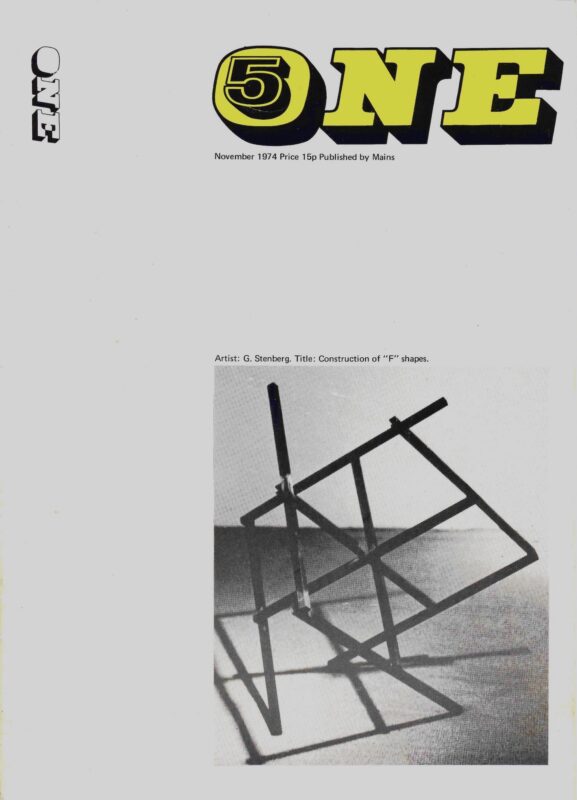
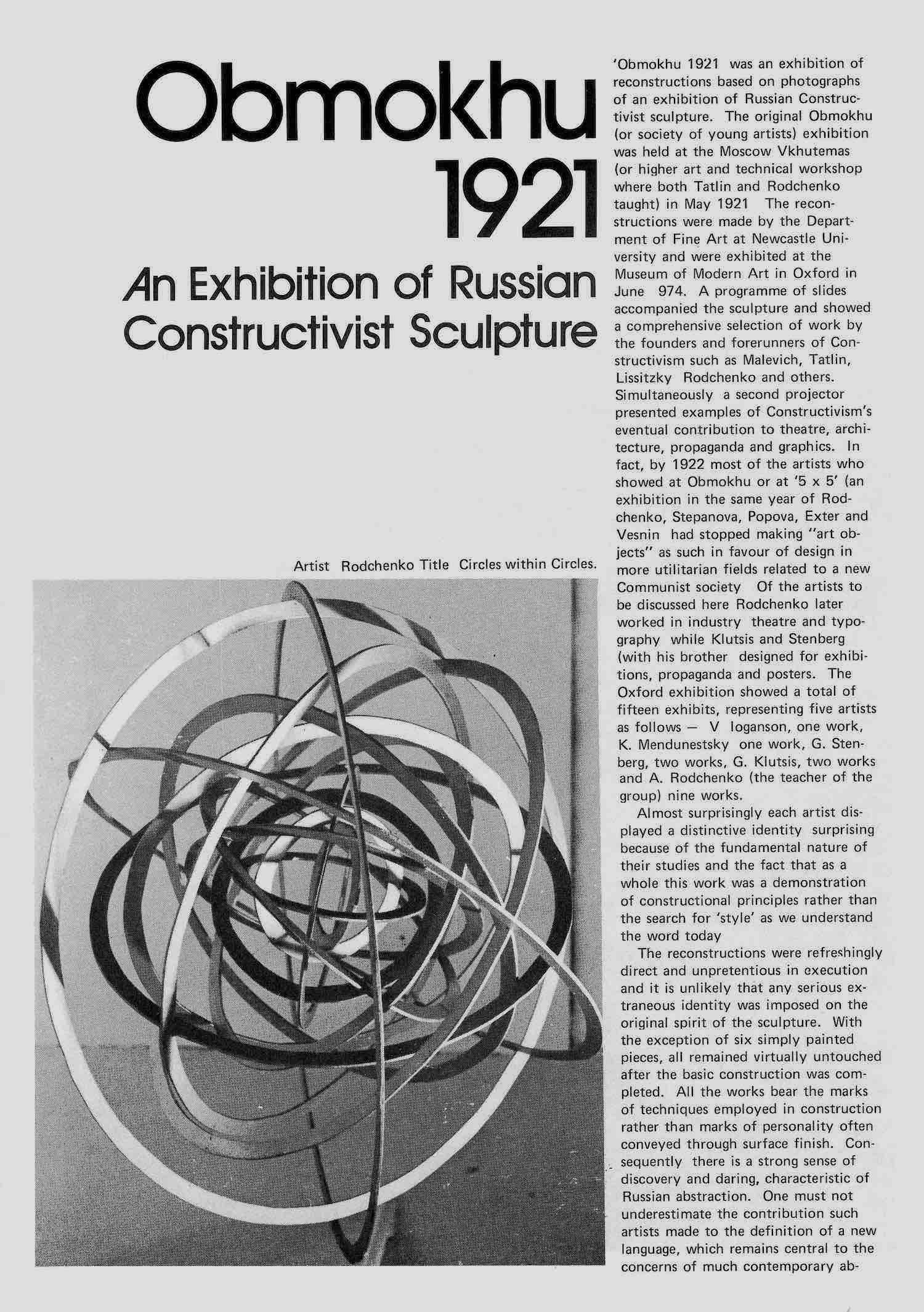
Two pieces by G. Stenberg combined the construction of open frameworks with the discipline of using equal units. Both sculptures were made with equal lengths of black, square tube, welded to form right angles, at regular intervals. Thus “Construction of Squares on a Triangular Base” and “Construction of ‘F’ Shapes” (the titles are descriptive) are what might loosely be termed ‘space frame’ structures. Both stand directly on the floor, and extend their influence over the surrounding space, containing a part of the room and without displacing the air. A parallel can be drawn between the solid body which displaces its own volume of water, with a submerged wire frame which displaces no water but continues to define volume. ‘Space contained equals space defined’ is a concern intrinsic to all the sculpture under discussion here, but nowhere is the idea so literally expressed as in four floating structures by Rodchenko from the “Surfaces Reflecting Light” series. These pieces are suspended by wire from the ceiling to float at head height and their titles, such as “Circles within Circles”, are also descriptive. Concentric shapes (circles for instance) were cut from a flat sheet and then revolved through the central axis or arranged at random within themselves, describing volume by linear means and forming a centrifugal whole which is reminiscent of the dynamics of atomic structure. Three of these models achieve an increased sense of weightlessness being painted silver and are thus reflective (hence the title of the series).
A sense of expansion, uplift or flight is especially evident in Rodchenko’s work but nowhere in the exhibition were these sensations evoked with such subtlety and economy than in Ioganson’s “Construction in Equilibrium”. Three straight metal rods of equal length rise from the corners of an equilateral triangular base, bisecting the angle of each corner. Where the rods converge and pass at a central point above the base they are prevented from touching, being supported with ingenious simplicity from the tops of the rods. Tension is created by the way the rods rise in such close proximity yet do not touch. Gravity is contradicted and a sense of exhilaration is experienced.
Broadly speaking, the sculptures described above form a stylistic and idealistic unity and this unity is itself defined by a Mendunestsky sculpture on one hand and two pieces by Klutsis on the other. Although dated 1921, Mendunestsky’s sculpture has a greater affinity with Tatlin’s reliefs of 1913-15 for example, than those concerns later explored by Rodchenko. Made from a variety of welded metal elements this piece maintained a strong sense of the sculptural figure, arrived at through the harmonic arrangement of disparate parts and as such is part of a tradition distinct from Constructivist tendencies at the time.
These eventual developments are indicated by the exhibits representing Klutsis, in particular “Kiosk with Screen” actually made in 1922 (after the Obmokhu exhibition). Employing a functional method of construction the kiosk was really an architectural project rather than sculpture and as such provided an influential connection between the two activities. The kiosk was ‘an open structure to display propaganda’ being related to the other architectural vehicles of Propaganda Art as championed by Tatlin’s Monument to ‘The Third Internationale’, embodying the results of the formal and aesthetic experiments made by artists such as those discussed in this essay, during the formative revolutionary years.
David Ward