IN THE AIR
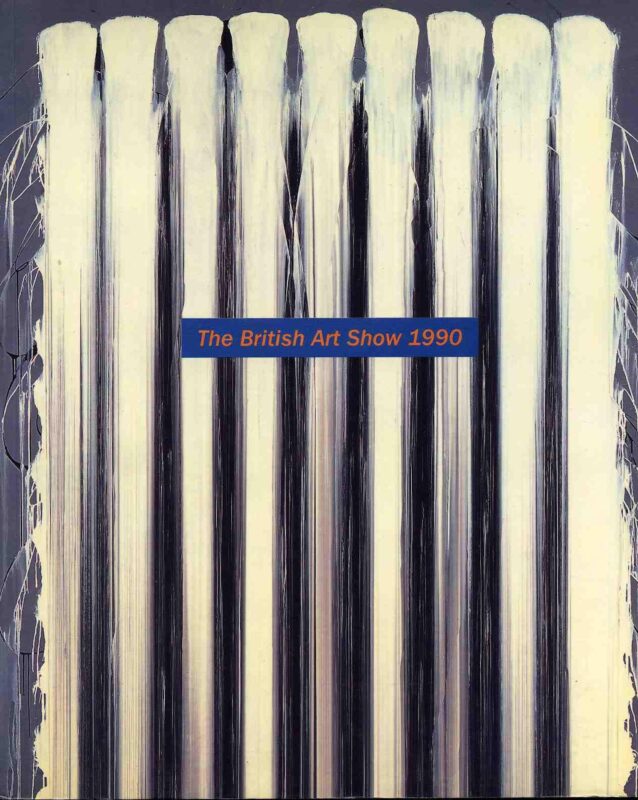
The British Art Show 1990
The South Bank Centre, London 1990
The British Art Show 1990 was selected by Caroline Collier, Exhibitions Organiser, South Bank Centre, London, Andrew Nairne, Exhibitions Organiser, Third Eye Centre, Glasgow and David Ward.
I. In the air
This exhibition brings together the work of over forty artists. Very few of them have ever exhibited work together before and, for all the participants, a large number of the other artists in the exhibition were, until now, completely unknown. For the artists themselves therefore, as well as for visitors to the exhibition, this is an unfamiliar gathering. No themes were pursued in selecting the work, no theoretical stance preferred and therefore the exhibition as a whole embraces considerable diversity – it is an exceptionally varied milieu within which to find even familiar faces.
It has been said that every viewing of an art work is in some way a first viewing and it is certainly true that to see the same work in different circumstances can transform it, or rather our experience of it, sometimes subtly, sometimes considerably. Within a group exhibition individual works are also seen in an interactive relationship (occasionally resonant, perhaps uncomfortable) with other works in the exhibition.
An exhibition such as this involves considerable preparation and research. And yet it does not exist until the works themselves come together in the gallery for the first time. No amount of forethought and planning can anticipate the actual apprehension and coexistence of the works themselves. Even as a selector, at the time of writing, I have seen the work only in the individual artist’s studios, often weeks or months apart; sometimes in progress, occasionally in the context of other exhibitions and a number of works will only exist as proposals until they are actually made for the first time within the gallery spaces.
As the selection of the exhibition developed I attempted to keep one principle in mind: to avoid forming generalisations about the work, the practice and the predicament of individual artists. Generalisations are useful but where we rely on impressions we risk losing sight of the particular and actual, for generalisations are invariably taken from the surface of experience. An exhibition is frequently seen as an event, bounded and contained, easily attached to fixed meaning. How we perceive such an event is not necessarily synonymous with how we may experience the art within it. A concern of this exhibition is to allow the art itself to become visible, rather than be obscured by the surrounding event: for the parts not to be subsumed by the whole.
These reflections express some of the ways in which this exhibition seeks to remain a fluid, unfixed project. Nevertheless this is a definite stance, a position intended to return us to the particular in the work of these artists and it is an attitude that reflects directly the extraordinary diversity of art being made now.
What then, is in the air? In relation to art this expression is often used perjoratively, to imply the fashionable, the temporal and insubstantial. It is, more positively, an expression that suggests the intangible, the idea of concerns, issues and influences that make up an atmosphere in which elements are identifiable yet not fixed and which are reluctant to be pinned down.
Naturally (or predictably), a question frequently posed during the selection was whether an emerging new tendency or movement is detectable: anticipation of new movements places an emphasis on what is about to occur, in the future, next in art, rather than focusing attention on what is present now. My response remains unchanged – that whatever constituents there might be circulating in the air a new orthodoxy has not crystalised. Indeed, ‘pluralism’ now seems an inadequate word to describe the present extent of diverse practice; the absence of a prevailing stylistic hegemony or dominant set of conventions or axioms; the dissolving of international styles and the re-investment of forms and languages with new meaning and life.
II. Without Walls
How we understand this dynamic condition of almost bewildering diversity and put it into context depends in part on changes in attitudes to, and the interpretation of, the history of art which is related both to broader concepts of history and to ideas of perception.
The subject of history is a central philosophical concern. The debate, from Kant to Foucault, has manifestations on many cultural levels and we gravitate towards the future during a period in which the concept and study of the past itself is undergoing continuous scrutiny and redefinition.
Now, at the beginning of the 1990s, it is difficult to remain immune to the excited anticipation of the significance of the approaching years. After all, this is not only the passing of one more decade. We have entered the ultimate decade of both the century and millennium.
We are witnessing the social and political transformation of central and Eastern Europe and the Soviet Union, a protracted process dramatically signified by the demolition of the Berlin Wall, a contemporary icon as powerful as the destruction of the Bastille two hundred years ago. Breaching the wall has tremendous symbolic importance but the implications and consequences of the changes taking place are not contained in that single historic act. It is timely to be reminded that Mao Tse Tung, when asked what the full significance of the French Revolution had been, replied that it was too soon to tell.
That remark reveals an attitude at odds with conventional perceptions of political history that tend to abstract linear sequences, one event leading to another in a continuous causal development towards the present. Art history is conventionally structured in a similar, horizontal, linear pattern in which artists and the concept of the masterpiece have an equivalence to major events in social history.
These interpretations of historical change are founded in a nineteenth-century idealism, based on an industrial revolution, rationalist philosophy and empirical science. As such these views serve a utopian idea of continuous progress and improvement in which the roots of the progressive avant-garde in art are found. But even the description of the avant-garde greatly oversimplifies the complicated interactive relationships between artists, in an attempt to impose at least a retrospective logic on art. This fixes art, as if historians and critics were cartographers identifying landmarks in vague terrains.
Indeed the image of landscape is a recurring metaphor. Umberto Eco, in the Aesthetics of Thomas Aquinas[1], describes the examination of the historical as the ascent of a tower to raise one above the surrounding landscape. Eliot employed the metaphor rather more dynamically in Tradition[2], describing, for example, the critical appraisal of art in which the relative stature of artists continuously changes as they recede, so to speak, in the perspective of a landscape of time. For Eliot this was a flexible process, always liable to be revised, and he goes on to develop the proposition that the art of the past not only contains within it potential for new art, but that, importantly, new art can also transform our perception of art that preceded it.
This concept of a responsive relationship between new art and the art of the past emerges in André Malraux’s text Musée Imaginaire (or Museum Without Walls[3]) which represents part of his attempt to dissolve orthodox art historical categories. Responding to the ubiquity of photographic reproductions of art and, I am sure, to Walter Benjamin’s ideas concerning the implications of mechanical reproduction in art, Malraux conjectured, controversially, that all art, of all periods and places of origin, becomes available, transformable and contemporary through reproduction. The museum, such a recently invented institution, no longer has walls and yet, as Eliot said of art history, nothing is lost.
III. There is more under the floor[4]
The sculptor Richard Wentworth has also used the metaphor of landscape to describe his own working sense of history but he has moved significantly away from the image of a receding plane to the sense of depth beneath our feet:
‘History, I think, is probably like a pebbly beach, a complicated mass, secretively three dimensional, and very hard to chart what lies up against what, and why, and how deep. What tends to get charted is what looks manageable, most recognisable (and usually linear) like the wiggly row of flotsam and driftwood, and stubborn tar deposits’.[5]
These lines provided me with a fresh insight into the renowned Situationist slogan of Paris 1968: ‘Underneath the paving stones lies the beach.’ – that below a carefully dovetailed and continuous surface lies a shifting texture of unresolvable complexity and potential.
The distinguished scholar of the seventeenth century Christopher Hill, with a certain oppositional edge, remarked recently:
‘The most fruitful change in historical attitudes in my time has been the emergence of “history from below” – the realisation that ordinary people also have a history. History no longer deals exclusively with Kings and their mistresses, Prime Ministers and wars…’[6]
There is an underlying optimism to all these images that relates to the recent redefinitions of historical change that I touched upon earlier. The past is no longer regarded as a given sequence of fixed events representing constant values that project us into the future. Rather history is a construct that we constantly remake, the better to understand our present.
When in Ulysses, Stephen Dedalus said ‘History is a nightmare from which I am trying to awake’[7] he also spoke for Joyce’s own position as an artist. For Ulysses is at once a modern work intimately bound both to a classical model and to Irish history. If for Joyce history assumed the metaphor of dream then what could he desire to awake to if not the present of conscious experience? This is not a present in denial of the past and (although for Joyce there was, I think, a strong element of historical inevitability) the suggestion is towards freeing oneself through knowledge and experience. Such aspirational thinking does not (to pursue the metaphor of the Odyssey) rely on being able to anticipate one’s course or destination. More recently, Michel Foucault, articulating the idea of philosophy as the art of thought, spoke of the intellect constantly seeking to unsettle its own habits of thinking – the capacity to aspire to depart from known experience and through this to realise and recognise, perhaps, a sense of return and actual presence in the world. (Foucault described this sensation with characteristically qualified optimism as both ‘comfort and dismay’).[8]
These are ideas of an essential fluidity in our understanding of our relationship to history and tradition. The imperative of progressive development and the concept of immutable, absolute values or essences being embodied in art are continuously dissolved or sceptically questioned and this has parallels in areas of scientific study.[9] The implication of research in physics now bears directly on our understanding of perception. That we are active participants in experience and not merely the observers of constant and objective phenomena has a special resonance with our engagement with art. Evidence in physics that conditions of observation affect the behaviour of that which is observed actively engages and integrates us with the world. While both science and art may provide us with models of reality, art may also involve us directly in experience of which we are potentially an inseparable part and which need not, finally, be mediated by word and language.
‘So language scatters the totality of all that touches us most closely even while it arranges it in order. Through language we can never grasp what matters to us, for it eludes us in the form of interdependent propositions and no central whole to which each of these can be referred ever appears. Our intention remains fixed on this whole but we can never see it in the full light of day. A succession of propositions flickering off and on merely hides it from our gaze, and we are powerless to alter this.’[10]
David Ward
- Umberto Eco: The Aesthetics of Thomas Aquinas, Radius, 1988
- T.S. Eliot: Tradition – from Selected Prose, Penguin Books, 1953
- André Malraux: Museum Without Walls – from Voices of Silence, Princeton University Press, 1978
- Parkett Art Magazine (There’s more under the floor), advertisement for Parkett, Zurich
- Richard Wentworth: The Sculpture Show, Arts Council of Great Britain, 1983
- Christopher Hill, Lies About Crimes, The Guardian newspaper, May 29, 1989
- James Joyce, Ulysses pg 31, The Bodley Head 1937-49
- Michel Foucault: The Regard for Truth/An Interview, Third Text No 16, 1984-5
- See Thomas Khun, The Structure of Scientific Revolutions, The University of Chicago Press, 1962-70 and Ilya Prigogine and Isabelle Stengers: Order out of Chaos, William Heinemann, 1984
- Georges Bataille, Eroticism, Calder and Boyars, 1962
Text © 1990 The South Bank Centre and David Ward
ISBN 1 85332 054 4