
UP, DOWN AND STRANGE – DEFYING GRAVITY AND ‘THE AGE OF BRONZE’
The eighth of eight sections in an essay, with seven photographs and an introduction by David Ward
in Casting the Die – ‘The Age of Bronze’ in Leeds
Centre for the Study of Sculpture, Henry Moore Institute, Leeds 1996
8: Up, Down and Strange[1] – Defying Gravity and ‘The Age of Bronze’
Bewildered critics of the sculpture when it was first exhibited objected that it was difficult to understand what the figure was doing. That ambiguity is precisely what sweeps me off my feet. Yet this is not an enigmatic figure, nor a cryptic image open to de-coding, reading and solving. It is not for example, a question of whether this body appears to convey rising or falling, reviving or expiring, desiring or grieving, potential or loss. Rather, in complex ways, both material and metaphorical, it is speaking of all of these oppositions at the same time.
Photographs of Auguste Neyt, modelling for the sculpture, show him holding this strenuous pose and gripping a supporting prop in the fingers of his left hand. All the weight of the body is supported on its left hand side, by the left foot – planted flat on the floor via the left leg although the knee is not stressed, up the torso – and by the left arm gripping that support. This is why the left bicep is swollen under muscular stress, because the angled arm is holding the body up, preventing it from rotating and falling forwards.
The right side of the body depends on that support and this enables the right foot to tilt onto the ball of the foot as if in preparation for a slight step to be made. But the slackening of the right knee allows the right side of the body to begin to swivel under the effort of holding the head and right arm in mutual tension. The right hip drops while the right shoulder rises in a stretch. The upward and backward movement of the head pulls the right arm up while the hand, clutching the hair, prevents the head from falling back under its own weight.
In removing the prop so essential to the support of the tiring living body from the rigid sculpture, the role played by gravity in the stance of the figure is brilliantly defied. While gravity acts on the body as a downward earthbound force, it is the studio prop which acts as the conductor of the muscular effort exerted in resisting gravity, like a lightning conductor, literally grounding the body.
Once that support is removed from the sculpture then the left foot and arm no longer seem to hold the body up but to hold it down, to prevent a tendency to levitate, like an anchor holding a buoyant vessel on the surface of the sea, and achieving this extraordinary oscillation of experience: between weight and lightness; of rising and falling, of gravity and grace.[2]
________________________
You’re walking. And you don’t always realise it,
says Laurie Anderson,
But you’re always falling.
With each step, you fall forwards slightly.
And then catch yourself from falling.
Over and over, you’re falling
And then catching yourself from falling.
And this is how you can be walking and falling
at the same time.[3]
________________________
Rodin described the movement or mimique that he aspired to instil into his work as the difference between attitudes of the body; from one position to another, and another. I understand the suspense of the body in ‘The Age of Bronze’ as akin to a barely perceptible, endless, luminous flickering, forwards and back, forwards and back, of a fragment of silent film.
If such an image, from a medium of light on the brink of occurring at the time that this sculpture was made, seems at odds with Rodin’s scepticism about mechanical representations of movement, then so be it. What I intend to imply however, is just what a transparent, shimmering, unstable and scintillating object this is. Always a wilful yet vulnerable sculpture, it remains buoyant in its utterly defiant refusal of fixed definition and meaning.
There is life in it yet.
David Ward
- Up, Down and Strange are some of the names used to distinguish between sub-atomic particles called Quarks whose behaviour or movement is unpredictable
- Thompson, Jon, Gravity and Grace: The Changing Condition of Sculpture, 1965-1975, Hayward Gallery, London 1993 (see p.24, titled from Simone Weil’s book Gravity and Grace)
- Anderson, Laurie, Big Science, Warner Brothers Records, 1982
Casting the Die was published as a result of a fellowship by David Ward at the Henry Moore Institute in 1995, which focused on the cast of The Age of Bronze by Auguste Rodin acquired earlier that year by Leeds Museums and Galleries.
Auguste Rodin (1840 – 1917), The Age of Bronze, Bronze, 1877 (this cast 1907), 178 x 60 x 61 cm, Leeds Art Gallery, Leeds Museums and Galleries. Purchased with the aid of grants from the Henry Moore Foundation, The Art Fund, the Victoria and Albert Museum Purchase Grant Fund, Raymond and Mary Danowski, the Leeds Art Fund and private benefactors, 1995
Text and photographs by David Ward
Edited by Penelope Curtis
© 1996 David Ward
ISBN 1 900081 75 X
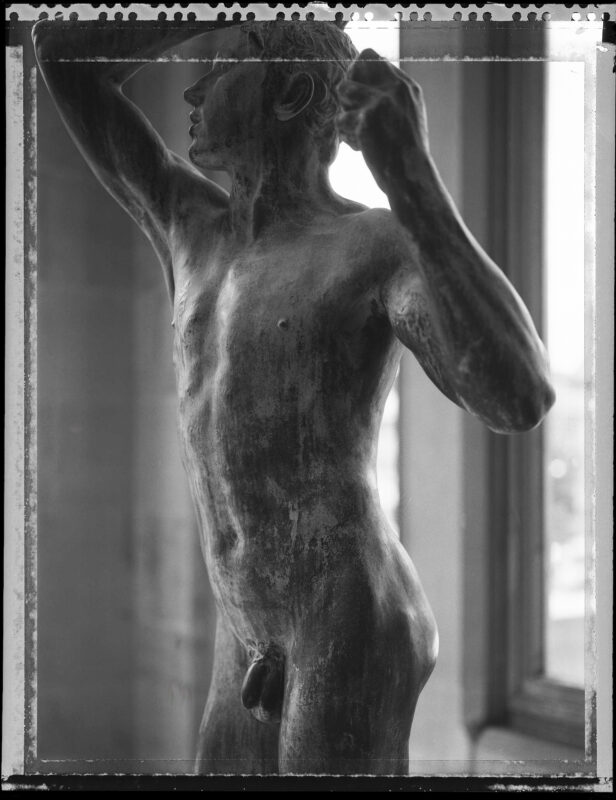
Casting the Die (Rodin) 1995. One of seven photographs by David Ward, of the cast of Rodin’s The Age of Bronze acquired by Leeds Museums and Galleries earlier that year.
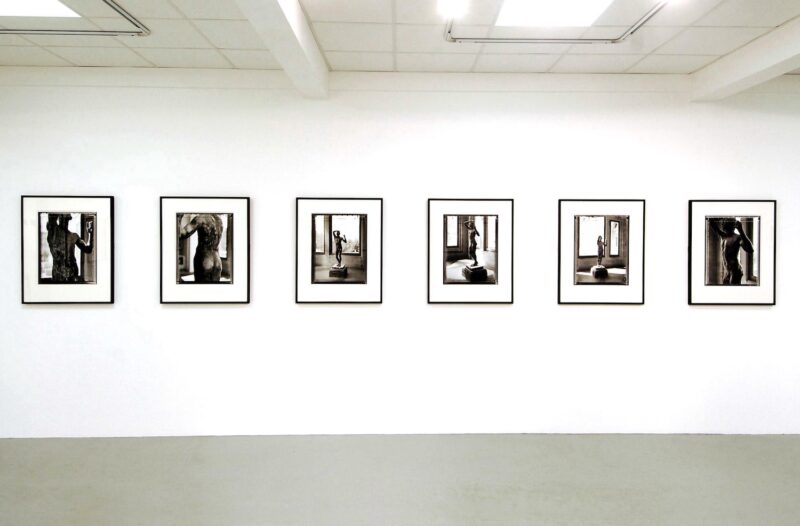
David Ward – Casting the Die (Rodin), 1995. Portfolio of seven silver gelatine prints, framed size 83.5 x 68.2 cm, (edition of 3), installation view.