ON THE RECLINING FORM
Commissioned essay for La Grande Horizontale,
curated by Penelope Curtis with Hidde van Seggelen,
for TEFAF (The European Fine Art Fair), Maastricht, The Netherlands
On the Reclining Form
He foresaw his pale body reclined in it at full, naked… .
James Joyce, Ulysses
I am not the spectator, I am involved, and it is my involvement in a point of view which makes possible both the finiteness of my perception and it’s opening out upon the complete world as a horizon of every perception.
Maurice Merleau-Ponty, The Phenomenology of Perception
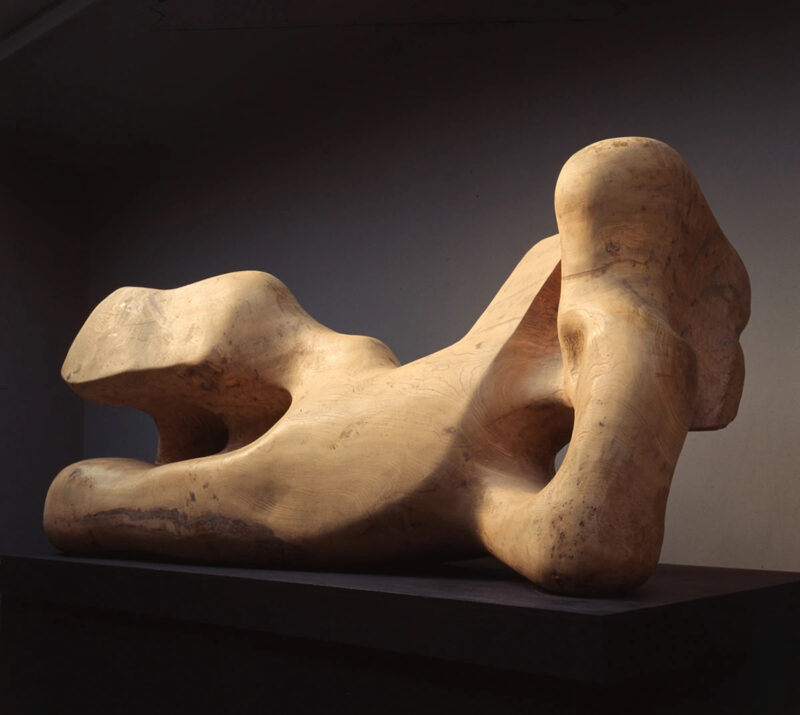
In the Henry Moore exhibition at Tate Britain in 2010,[1] the final room was occupied by four closely related sculptures. The very large elmwood carvings, elevated on plinths, were all reclining figures. One of these, ‘Reclining Figure’ (1959-64) exerted a strong physical and emotional effect on me, inducing affects that were not generated by the three other related works. Seeing this particular sculpture was a compelling experience of an intensity that was quite unexpected. I had seen the sculpture before but never like this. This essay reflects on the subjectivity of the experience and attempts to cast some light on the reclining figure and how we might relate to these forms, such significant presences, from the art of historical traditions to the art of our own time.
Translate – to move or carry from one place or position to another
In 1983, in the essay Richard Serra: A Translation,[2] Rosalind Krauss wrote about the work of Richard Serra for a French audience. She did this through the lens of the work of a great French philosopher of perception, Maurice Merleau-Ponty, in particular through his book The Phenomenology of Perception.[3] She addresses the different effects of his ideas in relation to Alberto Giacometti in Europe in the 1940s (when the book was first published, in French), and then to Richard Serra in the USA in the 1960s (when it was translated into English for the first time).
The essay employs this historical and cultural ‘gap’, of time and place, together with the act of translation, as a way of articulating a phenomenology of Serra’s sculpture. Via the filter of Merleau-Ponty’s ideas about the body, Krauss explores the significant differences between Giacometti and Serra, including figuration and abstraction, distance and proximity and scale, elaborating, in other words, the very different effects on these artists of the same philosophical work.
What is of particular interest here, in thinking about a phenomenology of the reclining figure, is the profound difference between the emphatic verticality of Giacometti’s post-war sculptures, his standing and walking figures, and the extreme horizontality of the works of Serra’s that Krauss chooses to discuss, especially the landscape work ‘Shift’ of 1970-72.
Elsewhere, on numerous occasions and in very different contexts, Krauss places considerable significance on physical and perceptual relationships between the vertical and horizontal: here from an analysis of Antony Caro’s 1962 sculpture ‘Early One Morning’:
The axis along which one relates to the work as object is turned ninety degrees to the axis which establishes its meaning as image. The change from horizontal to vertical is expressed as a change of condition or being.[4]
And again, talking about shift in the photographic works of Cindy Sherman:
…one of her most powerful weapons…is the rotation of the image out of the axis of the vertical and onto the horizontal of the informe.[5]
Merleau-Ponty himself places great emphasis on the idea that our perceptions of the world, ‘le monde perçu’, are orientated in relation to our upright posture, a concept central to Gestalt psychology. It is this Gestalt that appears to bring a particular dynamic to our experience of the reclining figure. And this turn, this rotation, this shift, between vertical and horizontal is itself a form of translation.
A fallen tree is transformed into a reclining nude. The vertical has shifted through 90° to the horizontal… .[6]
This line was written by Nigel Greenwood in the catalogue essay that accompanied the Hayward Gallery Annual exhibition, curated by him in 1985 and that also included Henry Moore’s ‘Reclining Figure’ (1959-64), the very sculpture mentioned at the start of this essay and to which we shall now return. Greenwood identifies the profound change of state of both the tree that the carving is made from, and the human body that the carving represents. Both tree and body have shifted through 90° to the horizontal. There is also a powerful physicality bound up in the impact of the gravity he expresses through the image of the fallen tree.
Implicit in this shift and the force of gravity there is perhaps a sense of a change of gravitational response in ourselves, within our own bodies. We stand while the sculpture lies down. Do we want to give our bodies to gravity and lie down too?[7] The reclining figure is a figure, a body that reminds our body of that shift. My body remembers and also anticipates, knows what the future holds. We may look forwards, with desire, or shrink with horror from a future state.
Certainly, my interaction with this Moore carving began as a visceral, bodily response. My ‘upright posture’ was put to work as the sculpture seemed to move me around the room. It positioned and fixed me and then troubled and de-stabilised me. I was impressed by its mass, and the five years of its making, yet it felt entirely un-laboured. And despite its size it felt experientially intimate and new. I was struck by its vigour and the erotic physicality of its formation and malformation, made restless by it and then settled by it. I was touched by something suddenly deeply harrowing, that afterwards reminded me of aspects of Michelangelo’s late ‘Slaves’. I would say that I recognised, and was seized, by the humanity of it.
Nigel Greenwood also says that he finds the sculpture ‘sympathetic’ and talks of Moore’s empathy for materials. A question then arises about such subjective experiences as empathy and sympathy in relation to the reclining figure. We may be familiar with expressions like: ‘I feel an affinity with the sculpture’. Yet my experience felt more as if the sculpture was responsive to me. What does it mean to say, to feel, that an object, a sculpture, is empathising with the viewer? To be a little more level-headed, so to speak, we would say of course that looking at the sculpture unlocks or rather releases empathy in us, forming our sense of meaningful relationship with it, fully comprehending the figure, identifying with it, perhaps, both mentally and physically.
…the ground of all experience of the relatedness of objects….[8]
I am proposing a kind of phenomenology of our physicality, as vertical beings, responding to the state of an object made horizontal. Sometimes Merleau-Ponty seems to be all about horizons: the horizon of the past, the horizon of the future, the internal horizon of the object, the body’s horizon. And while this is in part about the extent, the delineation of perception, how far we can see, it is profoundly bound up with the body as primordial, as he says, the ground of all experience of the relatedness of objects and therefore with our fundamental sense of orientation in the world.
The standing figure in sculpture can be an emphatic statement of the individual self, an assertion of being in the world, of presenting, declaring: she is, he is, I am. The sculpture stands. I stand.
Merleau-Ponty suggests that to turn an object (his example is the human face) upside down, is to deprive it of its meaning. I suggest that to rotate the body image to the horizontal is to transform its meaning.
The reclining figure, in contrast to the standing figure, is open to, inflected by, associations of a different spectrum of human states and experiences, of being in the world and even absent from it: of sleep, of dream, of oblivion, of death. Of exposure and vulnerability or of display and indifference. The capacity for a viewer to identify with the work of art, to experience a sense of affinity, embrace other orders of experience, is transformed.
In that physical and emotional recognition, empathy is the flux that releases a flow of associations, or the spark that galvanises and illuminates constellations of relationships with our own experiences and other works of art. In this way, one reclining figure will draw to it recollections of others from a great trans-historical and trans-cultural ‘genre’, if I can use that word.
I suggest this may occur through important dimensions of formal resemblance, but also the form is especially charged with a remarkable capacity for embodiment: to physically embody shared human experience, common states that are deeply meaningful in our lives. Of interiority, intimacy, emotion, loss, desire. It is this capacity for the embodiment of shared experience that brings about a luminous reciprocal identification with the reclining figure, on the part of the viewer:
Figure reclined
Vertical tree, fallen or felled
Vertical human form reclines, or inclines
Towards being parallel to horizon or ground plane
Supine, on the back, flat-out, face up, palms facing up
Declined, sloped down, a declivity, as on a hill
Prone, prostrate, face down, flat-out
Collapsed as in illness
As presented in death
Body displayed
As in sleep
Pieta
Vulnerable
Confident
Exposed
Exhausted
In desire
In abandon
Abandoned
Accepting gravity
Laid down, laying down
In repose, leaning back as when resting, in comfort, as when afloat
As when afloat
After seeing the Moore sculpture, other works of art began to cascade by association, leading me first to a late 15th-century religious carving of a recumbent figure of Jesse[9] from the church of St Mary, Abergavenny in Wales seen here as an idol, supported on a plinth made by Richard Deacon in the exhibition Image and Idol: Medieval Sculpture curated by Deacon and Phillip Lindley at Tate Britain in 2001.
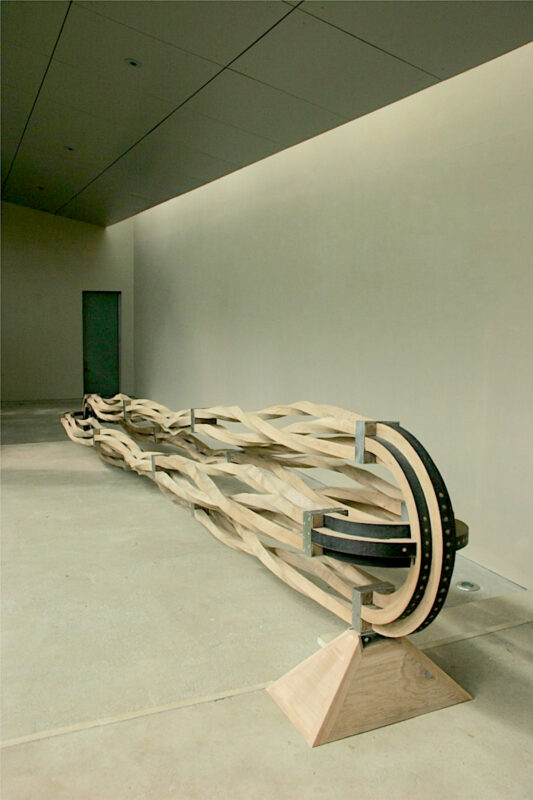
Beyond this lies Orinoco[10], a streaming flow of worked wood that is a Richard Deacon sculpture, remarkably reminiscent of the robust carving of the beard and robes of the Jesse figure, which is itself turbulent, like currents of water. The structure is supported, or rather propped, on a small wooden pyramidal object. The sculpture is not a representation of a human form in any way and yet it does relate, to my mind, with the formal structure of the reclining figure in the sculptural tradition. The geometry of the prop is an echo of the triangular shape typically made by the crooked elbow of an arm that frequently supports the torso of a reclining body in sculpture, as is the case in Moore’s reclining figure.
Deacon likened his sculpture in situ to ‘shooting the rapids’, a dramatic, river analogy that emphasises both the sculpture’s directional dynamic and its angle or inclination and, for me, affecting the sense of my own body, as vertical viewer, inserting me feet first into the horizontal current of the sculpture. I was shifted through 90˚ to the horizontal. Swept off my feet.
Merleau-Ponty, in the script of his 1948 French Radio broadcast series World of Perception wrote:
One of the greatest achievements of modern art and philosophy has been to allow us to rediscover the world in which we live, yet which we are prone to forget.
This quiet line seems to anticipate the more charged, sensual language of Susan Sontag in her polemical essay Against Interpretation of 1964[11], when she concludes her text saying:
What is important now is to recover our senses. We must learn to see more, to hear more, to feel more.
She ends with a single, short sentence:
In place of a hermeneutics we need an erotics of art.
Perhaps, in turn, we may conclude by returning to Nigel Greenwood’s image of the felled tree, but now afloat, and cast off with James Joyce’s description of Leopold Bloom taking his morning bath[12]:
He foresaw his pale body reclined in it at full, naked, in a womb of warmth, oiled by scented melting soap, softly laved. He saw his trunk and limbs riprippled over and sustained, buoyed lightly upward, lemonyellow: his navel, bud of flesh: and saw the dark tangled curls of his bush floating, floating hair of the stream around the limp father of thousands, a languid floating flower.
David Ward
- Henry Moore – Tate Britain 24 February – 8 August 2010
- Rosalind E. Krauss, The Originality of the Avant-Garde and Other Modernist Myths,
The MIT Press, 1985 - Maurice Merleau-Ponty, The Phenomenology of Perception, Routledge, 1962
- Quoted from Krauss’ Passages in Modern Sculpture, The MIT Press, 1977
by Jon Thompson in Gravity and Grace. South Bank Centre, 1993, p.15 - Yve-Alain Bois, Rosalind E. Krauss, Formless: A User’s Guide, Zone Books, 1997 p.103
- Nigel Greenwood, A Journey Through Contemporary Art with Nigel Greenwood, Hayward Gallery 1985 p.2
- A recent exhibition by sculptor Daphne Wright included her work Stallion (2009), a cast of a dead horse, lying on its back on the gallery floor, itself a powerful and moving reclining figure. Some visitors to the exhibition were to be seen lying down, close to the cast of the dead animal. Daphne Wright: Emotional Archaeology, Arnolfini, Bristol: 30 September – 31 December 2016
- Maurice Merleau-Ponty, The Phenomenology of Perception, Routledge 2012
- Richard Deacon designed all the plinths, supports and barriers for the exhibits. See: Image and Idol: Medieval Sculpture Richard Deacon and Phillip Lindley – Tate Britain 2001
- The Sculpture was first exhibited in: Orinoco: Richard Deacon and David Ward at the New Art Centre, Roche Court, Wiltshire 2007 – showing works made in relation to both artists’ experiences of travelling on the Upper Orinoco River in Southern Venezuela
- Susan Sontag, Against Interpretation (1964) – A Susan Sontag Reader, Penguin Books, 1983, p.104
- James Joyce, Ulysses, The Bodley Head, 1993, p.71 line 567
Text © 2017 David Ward
ISBN/EAN 978-90-75375-25-1