
Yves Klein now: Sixteen Views
Published on the occasion of the exhibition Yves Klein: Leap into the Void,
Hayward Gallery, The South Bank Centre, London 1995.
Introduction and editing by Martin Caiger-Smith and one of the sixteen views by David Ward
Leap into the Void is an unusual representational image, in contrast to the sensual, non-representational realm of the vivid and elemental materiality of Klein’s work. In its depiction of a Promethean desire it is reminiscent of Merleau-Ponty’s dynamic phenomenology. Klein inserts the image of his own body, in an energetic and compulsive act, seeming to take flight into the suburban space of a generic French photograph. It is a flight that co-exists with the mundane world of a cyclist who is also, however, only prevented from falling by maintaining momentum.
Leap into the Void depicts a defiant attempt to break more than just the ties of gravitational force. It does not appear as an angelic flight, like the aerobatics of the visiting angel above Constantine’s tent in Piero della Francesca’s Arezzo frescos. And unlike the angel performed by Bruno Ganz in Wim Wenders’ film Wings of Desire, who is made suddenly and ecstatically mortal, the image of Klein’s body is forever withheld from an unceremonious fall.
Klein is caught in the act of pressing against a resistant atmosphere, like Buster Keaton straining into the teeth of the wind, and willing a permeability to occur in an invisible surface. It is a pressure felt in Klein’s anthropometries in which the trace of the body can be seen to be impressed into visibility against the material surface of the work. And it is a permeability to be experienced perceptually and imaginatively in the face of the blue and absorbent monochromes.
The constructed and brilliantly self-promotional image is not a performance, but it is a performative gesture. It is also a gesture in a political sense: as an act that is expressive of a position, a resistant and non-conformist stance. This irrepressible image confounds superman mythologies. It is elating, vitally comic, compelling and inspirational.
When I was a child, being taught about what I later understood to be velocity and trajectory, I was told that in the shipyards (which still flourished then) riveters worked like this: each red-hot rivet, taken from the fire with tongs, would be hurled vertically from the ground, up to the scaffolding above, where the still incandescent object was caught in a metal cup. The skill lay not only with the catcher, but in gauging the throw, so that the zenith of the trajectory was at exactly the height at which it was to be caught. At that precise point the rivet would be momentarily motionless – neither going up, nor coming down.
Klein’s Leap into the Void is held somewhere like that.
David Ward
Text © 1995 David Ward
ISBN 1 85332 139 7
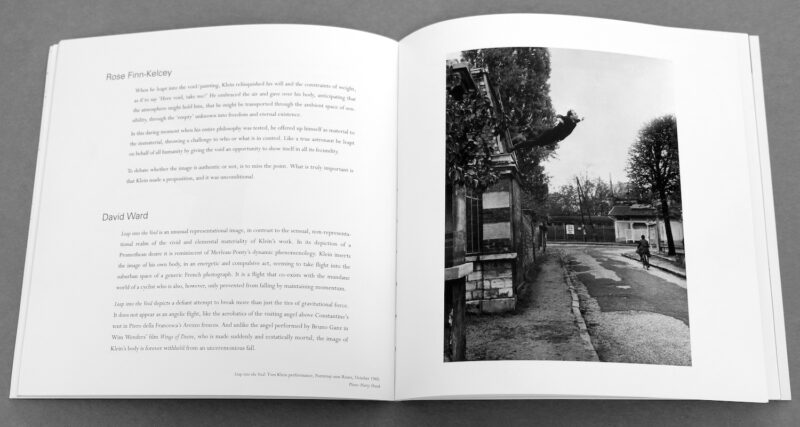
Yves Klein now – spread, including Yves Klein, Leap into the Void, Fontenay-aux-Roses, October 1960.
Photo: Harry Shunk